The Ball relies on your help. Please consider donating via Paypal.

Children with an Alive & Kicking ball

The Ball meets Salif Keïta

March 17th, 2010 by The Ball

“You can’t talk about football in Mali without talking about Salif Keïta”
– Kassoum Keïta (no relation) from DHL Mali.

Salif Keïta is not just famous in his native Mali, he one of Africa’s footballing legends. In 1970, he became African Footballer of the Year, the first person to be awarded the prestigious Ballon d’or Africain.

Salif Keita wins the Ballon d'or Africain
Salif Keïta being awarded the Ballon d’or Africain

Keïta, now in his sixties, is the owner and proprietor of the beautiful Mandé Hotel, gloriously situated on the banks of the Niger River in Bamako. We head over there to meet him.

We are met by the concierge at the Mande Hotel

“Please wait while I call through,” says the concierge.

Like so many, Keïta had grown up poor in Bamako, Mali in the 1950s. Football was his escape from poverty playing for AS Real Bamako and Stade Malien. His incredible talents saw him lead Mali, as a teenager, to the most success the nation was ever to have –- second place at the 1972 African Cup. Unfortunately, he picked up an injury and was unable to play in the final.

The Malian government were investing heavily in football. Their thinking went something like this: if we are successful at football, the masses will be content and less likely to fight against us. It has been a ploy used by political leaders across the continent ever since. In Africa, footballing success can be the difference between keeping power and losing it.

Salif Keïta, the young superstar, was Mali’s hottest asset. It didn’t take long for several top European teams to become aware of the shooting star, but he wasn’t allowed to leave the country. Keïta, however, had already made the decision to leave Mali and head for Europe. He escaped Mali overland and made his way to France where he was picked up by St Etienne. His career took him to Olympic Marseille, Valencia in Spain and to Sporting Lisbon. Nicknamed “The Black Pearl of Africa”, Keïta’s goalscoring exploits and outspoken honesty made him a household name in Europe, and a hero across Africa.

A conversation with Salif Keïta

Salif Keita holds The Ball

Salif Keïta greets us with a warm smile and we sit down to talk.

The Ball: What is the “spirit of football”?

Keïta: Football is a game that can help people to live together, to have a partnership and to have a friendship. Everyone watches the World Cup final and everyone is ready to be happy with the team that wins or sad with the team that loses. The spirit of football is perfectly forming people together. In this moment the world has many problems and football can help us to solve some of those problems. The spirit of football is for people to accept others.

What do you think about the state of football in Africa at the moment?

African players are playing in teams in top European leagues… Drogba, Eto’o, Traore, etc. Two days ago I saw Egypt lose to England. They were very unlucky. Senegal beat Greece. Cameroon tied against Italy, and Ivory Coast lost to South Korea. I think that African football is in very good shape. A big problem is money. We don’t have money.

What do you think that so many talented young African players are playing in Europe? Is it a problem for African football?

You cannot pay players in Africa like the Europeans are doing. In sub-Saharan Africa we cannot afford to pay the players. If we had the money then maybe they will stay. But you cannot blame young players going to Europe. You cannot stop them.

What are the chances of an Afrian team winning the World Cup?

It will be difficult but it is not impossible. If it happens, nobody can be surprised.

Could Ivory Coast win with Guus Hiddink as the coach?

Maybe he can do something. But he is not playing! (laughter) They are down in confidence. Hiddink can give them some advice. If the players are not right in their own heads then it is difficult. After they lost the African Cup and they lost to South Korea they are very low in confidence.

Nigeria was a big surprise in the African Nations Cup. Everyone said after Egypt beat Nigeria that Nigeria was finished, but they went on to make the semi-finals. They are a good team. I think Cameroon, even thought they are not like they were 10 years ago, can go very far. Ivory Coast, Ghana, even Algeria — they are all good teams. And South Africa are young and they could surprise, they are at home. You never know in football.

Are you going to be in South Africa?

I am invited to go to South Africa but I prefer to watch the games on TV. A while ago, when I was watching France–Ireland, I saw exactly what happened with Thierry Henry’s goal. People in the stadium had no idea. They were too far away. You can’t see this in the stadium. It is too fast live and you are too far away and there are no replays. I like to watch football on TV.

What do you think about the Henry incident? Is Theirry Henry a cheat?

What happened with Henry could happen with any player. It is a reflex. Immediately, he had to do it because he wanted to win. He saw the ball in the net and he was happy. After the match, he went home and everybody said that he used his hand. No, when you are playing you want to win.

You supported a project about cleaning up Bamako. Cleaning up the streets which are full of trash. You did this by using football as a lure to make young people aware of their civic duties.

It is difficult here because you do not have the possibility to continue to do things because there is not enough money. Often projects are a once-off. For success you need to put people to work and talk to them. It can last for a few months or a year. It is not easy. You need to change the mentality. This can only be done through education. When I was young we used to clean the streets every Monday. Everyone would join in. But now, they do not even think about this. And you cannot do it by yourself. People need to understand the problems and the consequences of their actions.

Last week in Dakar, we met Bashir, a Senegalese man who had returned to Senegal after Senegal beat France in the opening match of the 2002 World Cup. He got on the first flight home and didn’t return to the USA. You hear about the exodus of people leaving Africa. But on this journey so far we have met people who have chosen to come back to Africa. Who are investing their skills in Africa. What do you think about the phonomenon of Africans coming back home?

Many Africans are coming back to share their experiences. I think the leaders of Africa need to utilise this, like China and India have done. But Africa doesn’t do a good job with this. When these people come back they have difficulties. But they are coming back to share their experiences. African government doesn’t understand this.

Footballing serendipity, Bamako-style

March 16th, 2010 by The Ball

It has been a long day of meetings with dignitaries. We haven’t eaten all day and ready for some food and then sleep.

We get out of Kasim’s car. Phil and Kasim head for the restaurant to order dinner. Lagging behind with The Ball, Andrew sees two children on the intersection of two dusty little dirt roads. One child comes to ask for money, holding out an empty paint tin. Andrew reluctantly shakes his head. “Non”, he says. Instead, he kicks The Ball to little lad. The boy’s eyes light up. The three of them pass The Ball back and forth, inviting two more boys to join in. Soon there are ten or more kids with him, juggling with The Ball in a giant circle.

Night shot of keepie-uppie in the street

Phil and Kasim have joined them now, and there seems to be talk of a game. Indeed, goals are being marked by large jagged stones. The dangerous ditches on either side of the road define the touchlines. The child who was begging for money offers Kasim his paint tin begging bowl. Kasim, duly appointed as referee, takes it — hitting it with a stick will do perfectly for a whistle. Game on. Skins against shirts.

Andrew considers himself lucky to be a shirt. However, his DEET-impregnated, anti-malaria shirt and trousers feel much too warm. It is 9pm and 30 degrees outside. He’s sweating and coughing up a storm in this little dust-bowl of a pitch. Phil takes his place — and the goals start flowing. Shirts win 3-1.

Phil poses with some of the players

This kind of playful interaction makes The Ball’s journey such a magical experience for us — it reminds us of the power that lies at the heart of the beautiful game. And for the little boy with the empty paint tin? Although we can only guess how he feels, perhaps his tin contains something more precious than money — memories of a ball which are his to keep forever.

Visa training: Ambassadour Extraordinaire

March 16th, 2010 by The Ball

We are off on yet another visa escapade. At the Burkina Faso embassy, we are met by stares from the receptionsists so icy they could power the air-conditioning.
“Fill out these forms”, they say.
Unexpected disinterest in The Ball and our story. Oh well, you can’t win everytime.

Resigned to our task, we get stuck into filling out three identical forms. To our dismay, there’s not a photocopier in sight. We take some time out from the paperwork to look at a map of Burkina Faso — to plot our route from Mali to Ouagadougou and then on to Ivory Coast by train.

We plot our route on a map of Burkina Faso

As we turn in our paperwork the Chef de Protocol comes out and stamps The Ball. He’s not interested in signing it. But our biggest mistake? We haven’t brought any money with us to pay for the visas.

So we’ve got exactly 30 minutes to get some cash and get back to the embassy. In the car and quick. Kassim from DHL puts his foot down in his white Mercedes, Mali seems to be the place where all of Europe’s old cars end up. Every second car is a Mercedes. Anyway, first bank: no luck, cards not working in that machine. Second stop at the North South Hotel and success! Olé olé olé! Cash in the hand, it’s back to the Burkina Faso embassy.

We arrive at midday, right on closing time. As we approach the embassy, the Chef de Protocol races out to meet us – excitement on his face. “The Ambassador wants to meet you. Now.” A surprise change of tack here — a much friendlier atmosphere, so upstairs we go. Straight into His Excellency’s reception room. Ambassadour Extraordinaire du Burkina Faso au Mali Sanne Mohamed Topan welcomes us with great warmth.

Ambassadour Extraordinaire Topan and The Ball
Phil, Ambassador Topan and Andrew under a picture of BF’s President

We sit down, tell our story and philosophise about the world through one football — The Ball. The most welcoming ambassador from one of the world’s poorest countries opens his arms to the project and tells us that he has decided to give us our visas for free – we’ll just pay for the tax duty on the stamps. We’ve won again.

Our visas for Burkina Faso
Stamps on our visas

And so we end up paying a tenth of what we could have done. What a wonderful gift to The Ball, which is doing this journey on the slimmest of budgets. Thank you, Your Excellency, we are excited to visit your country next week.

The Malian Football Federation

March 15th, 2010 by The Ball

The Malian Football Federation logo
The emblem of the MFF at the entrance to the MFF

Phil has been practising a song about The Ball called “This ball is our ball” based on Woodie Guthrie’s famous tune for the people of the United States: “This land is our land”. He performs it for the first time to a live audience. Malian’s love their music and Phil ain’t half bad. The Ball certainly helps to break the ice at such events and Phil’s music adds to the fun.

But the star of this show was the President of Special Olympics, Mama Garba Tapo who called the press to atttention about the problems facing children with special needs in Mali. He spoke directly to the press: “Without your support, nothing is possible.”

Andrew and the VP of the MFF
Andrew and the Vice President of the MFF

After several questions from the press about The Ball we talk about the project with the Vice President of the MFF Monsieur Toure. I ask him if we would be able to meet the famous Salif Keita, dubbed “The Black Pearl of Africa” by the press in Valencia. He is one of Africa’s footballing legends and perhaps the first sub-Saharan African footballer to make it big in Europe. Indeed, there is a brilliant french film entitled Le Ballon D’or based on his life. “No problem,” says Monsieur Toure. A meeting with the man himself is organised for the next day.

Ensemble Instrumental at Carrefour des Jeunes, Bamako

March 12th, 2010 by The Ball

Kadi from DHL is our designated driver and translator for our press conference with the Minister of Sport and Special Olympics. Her boss, Djelika, reminds her that punctuality is vital on this occasion. Kadi is, she freely admits, prone to tardiness — join the club, Kadi.

To her credit, she arrives right on time in her pick-up truck and we are also just about ready to go. Phil climbs into the passenger seat and Andrew leaps on the back. It’s our first morning in Bamako traffic; an interesting experience. Old European cars in the designated car lanes and new Chinese mopeds and motorbikes in the bike lanes. We pass a huge sign hanging outside a government ministry saying “Ride bikes for a cleaner Bamako.” Not a bad idea, but a seemingly hopeless cause. Bamako is highly polluted, with no regard for laws on emissions (if indeed there are any) and traffic congestion is out of control. To top it all, there seem to be more and more people moving to the city.

Bamako bike rider

As we cross the Niger River and head into town, Andrew has our trusty Sony video camera (kindly lent to us by Africa10) in his hand, snapping up everything in sight. He quickly finds out that people are very wary of visitors filming them. It’s a common sentiment in poorer countries around the world, where people think their image might be exploited by the photographer, perhaps appearing on a postcard or in a magazine. As we near our destination, we are confronted by locals pointing at the camera, indicating clearly that filming them is not okay. We can understand their point of view — although these scenes look exotic to us, to them this is normality. In our defence, we feel that we’re not just taking photos away, we’re also bringing something with us: The Ball.

Phil greets the Ensemble Instrumental with The Ball

We arrive at the Carrefour des Jeunes cultural center, we are met by Ensemble Instrumental, a musical group paid by the government to perform at state occasions. Special Olympics athletes and administrators are in the courtyard to greet us as the band steps the music up a notch.

A singer with Ensemble Instrumental

There are more than ten of them in the band: five or six dancers, one man on marimba, two guys on talking drums, a singer and a djembe player. The Ball lands in the middle of the group and Phil jumps on the microphone to add his voice to the mix.

An Ensemble Instrumental musician

A drummer with Ensemble Instrumental

The Ball in the mix
The Ball in the mix

The press conference that follows includes an official presentation of The Ball to the representative of the Minister of Sport, Mr. Morike Traore, words of welcome from the president of Special Olympics Mali, Mr. Mama Garba Tapo and Salif Moulin Diallo, the head of the Paralympic movement in Mali.

Dignitaries at the press conference
Morike Traore and Mama Garba Tapo

The Chinese Ambassador joins us on the podium: from construction through to sport, the Chinese are not missing a trick in West Africa. We stay for a quick TV interview and then we’re on our way again — a little bit wiser about local fears as well as local hopes.

Next up: visa training Burkina Faso-style, followed by a personal audience with the Governor of Bamako. A flavour of just one day in the life of The Ball 2010. Stay tuned.

DHL cargo flight: Dakar to Bamako via Mauritania

March 11th, 2010 by The Ball

We have been in the DHL office all afternoon copying footage onto hard drives, writing for the blog, taking pictures with the DHL staff and The Ball. Our time in Senegal is coming to an end: an overnight DHL cargo flight awaits us. We are properly hungry by now so Bashir has a idea. “We have time to visit my mother, boys. She wants to meet The Ball. Then we are having some traditional Senegalese food for dinner. Rice and fish.” Okay, that sounds like a plan.

At home with Bashir
With Bashir and his mother in their lovely home.

The flight is scheduled to leave just after 10pm. Bashir reassures us. “We have time. We don’t have to be there until 10pm at the very latest.” Great, we have time to eat. Or do we? There has been a power cut at Bashir’s; we find his house is candle-lit. All very romantic. The good news is that the food is prepared.

Just then, Bashir’s phone rings. It is Basile at the airport. “Where the hell are you?” he screams down the phone. Oh dear, there’s been some miscommunication — it turns out we had to be at the airport 20 minutes earlier. We might even miss the flight. No time for food now. As soon as we can, we head for the DHL depot at the airport. Frantic faces greet us.

Andrew hugs Basile, who is looking nervous
Basile and Andrew… Basile looking very anxious.

We are escorted through the airport by Basile. “DHL (pronounced Day Hasch El in French) cargo flight,” says Basile as we jump the immigration queue. He repeats this as we go to the front of the security check-in line. In five minutes we have cleared security and customs and are on the tarmac. Basile has one more trick up his sleeves. He waves down a large airport shuttle bus, commandeers it and once more tells the driver “DHL cargo flight.”

Plane-side in Dakar airport
By now it is a quarter past ten and we are plane-side.

We reach the plane and Phil takes The Ball and chips it Remi Gaillard-style first time on board and celebrates first by wheeling away, then coming over to celebrate with me. We celebrate not just the goal, but the fact that, thanks to Bashir and Basile, we’ve made the flight on time. We will be leaving for Mali today.

Phil celebrates his goal
Phil celebrates his goal — and catching the plane

Time for take-off, up and away to Nouakchott, the capital of Mauritania with Phil in the jump seat and Andrew back cargo-side in one of two other seats, sitting next to a distinctly non-talkative US government official. Our 15 minutes in Mauritania allow The Ball to be kicked on the tarmac and a single solitary Mauritanian signs The Ball.

The only person to sign The Ball in Mauritania

Back on board and off to Mali, this time Andrew taking his turn in the jump seat. His first thought — to give The Ball to one of the pilots for an onboard portrait photo.

One of the pilots with The Ball

We arrive at 4am in Bamako and a friendly DHL employee is the first to head and sign The Ball in Mali. It is dry and it hasn’t rained here for months. It’s a reasonable 25 degrees right now, but the expected high later in the day is 45 degrees. We’re a little bit daunted by that figure. But there’s no time to dwell on weather reports as it’s off to our hotel where a surprise awaits us. More than 10 Special Olympics Mali administrators and athletes are there to greet us.

Special Olympics greet The Ball in Mali

Fantastic! What a welcome. We’re overwhelmed by the reception. But for us it is time to get our heads down and sleep — at least for a few hours please?

Around Dakar

March 11th, 2010 by The Ball

A collection of random moments in Dakar. We’re about to leave for Mali, but wanted to post these to give a flavour of this football-obsessed city.

My ball!
No, you don’t understand — it’s my ball!

Children watch a game of table football

Beach football is everywhere

The sun sets on The Ball's time in Senegal
The sun sets on The Ball’s time in Senegal

Next up, The Ball heads onwards to Mali for adventures on the southern edge of the Sahara.

Relaxing on Ngor beach

March 10th, 2010 by The Ball

So what do we do when we’re not chasing round on one footballing mission or another here in Dakar? We take a stroll along Ngor beach and enjoy the relative cool of the late afternoon. And play some football, of course!

Andrew on Ngor beach with the Pauli's mascot
Andrew with the mascot his son Pauli gave him

The temperature is dropping and the sun is starting to set, plunging straight into the sea. Who are those guys walking towards us? A team of footballers? Yes. Certainly. These guys look like professional athletes — they have amazingly toned bodies. “Phil, they have to be a football team,” Andrew suggests.

Phil immediately approaches them and explains The Ball and the journey and is welcomed to join their “light” training session the day before an important cup match. Phil whips his shirt off, revealing a great British blindingly-white torso.

Phil's English "tan"
Phil shows off his classic English “tan”

Soon the team and their latest starlet start jogging up and down the beach. While Phil’s energy quickly drains away, their pace ramps up to a furious level and Phil rolls out of the pack in a heap. As the professionals continue their light warm-up, Phil resorts to some more gentle keepie-uppie instead.

Keepie-uppie on Ngor beach

By this stage, Andrew is keen for a game of beach football. Organising a game of footy in Dakar is just about the easiest task you could ask of someone. People simply love their football here — and play just about anywhere and anytime they can.

Celebrations on the beach
Enthusiasm for the game is never far away

In a flash, its 3 against 3, with stones as goals. The tide is coming in and The Ball, being made completely of African leather, is soaking wet in no time. No matter, game on. 3 against 3 becomes 5 against 5. Two French surfers join in. They are spending a month in this surfing Mecca, where the local Wollof-speaking fishermen have surfed for years on the beautiful rollers that frame the nearby Ile de Ngor.

The Ngor beach team
The Ngor beach players pose for the team shot

This idyllic beach harbour is the perfect place to wind down after the intensity of the last few days. Football for football’s sake. A welcome break.

A diplomatic mission in Dakar

March 10th, 2010 by The Ball

We hone our diplomatic skills as Special Olympics Senegal organise a visit to Dakar’s City Hall.

Dakar's City Hall
Dakar’s City Hall

We’re beginning to understand that, this time round, The Ball’s journey is more than just an exercise in “happy-go-lucky” serendipity and has a more serious element to it. Meeting the children at the special needs schools impressed on us just how important The Ball can be to them and that we have a responsibility to make The Ball as good an ambassador for their cause as we can. And so we’re off to meet the Mayor of Dakar on their behalf.

It turns out that the Mayor himself is otherwise engaged and so The Ball is introduced to the First Deputy Mayor. The meeting takes place at an enormous long table with a central channel for The Ball to be rolled down. The Deputy Mayor takes great interest in the journey and our partnership with Special Olympics and can’t resist a spot of keepie-uppie out in the hallway.

The Deputy Mayor plays keepie-uppie with The Ball

He promises to grant Special Olympics athletes access to a number of sports facilities for training and other activities. He also asks Special Olympics Senegal to send him a list of their needs for further consideration.

The Hotel de Ville team
It’s all smiles for the The Hotel de Ville team

We hope that The Ball has helped Special Olympics Senegal to open some doors to the administrative and political authorities in Dakar. And, more importantly, that they stay open once it has moved on.

Pilgrimage to Ile de Gorée

March 9th, 2010 by The Ball

Dakar is on a peninsula and is said to be the nose of Africa and that Africa breathes through it. We take a morning ferry from Dakar to Ile de Gorée — an island off the coast of Dakar — with Mademba Mbacké, Directeur des Programmes Special Olympics Senegal. From this seemingly idyllic island, millions of Africans, who had been rounded up throughout West Africa (and as far east as Sudan) in the 19th century, were exported as slaves to the USA, Brazil, the West Indies and Europe. 50% of them died in transit.

Andrew and Mademba Mbacké

Our first stop is the last remaining slave house. It was in here that thousands of slaves were crammed, awaiting their fate. When Nelson Mandela visited the island, he insisted on crawling into the tiny prison room of this house. 6 or 7 people were crammed into this tiniest of cells under the stairs, without a window and excruciatingly hot. Mandela came out shedding tears.

Peace painting on Ile de Gorée

Let freedom ring. Girls from the traditional all girl school Maison D’Education Mariama Bambaras painted a series of peace paintings on a memorial wall on Gorée.

Peace paintings: let freedom ring
The memorial wall

A memorial statue on Ile de Gorée

As a sign of brotherhood and respect, the brothers of Guadeloupe donated this memorial statue to the brothers of Africa. It is a statue of the liberation of slavery sent from the West Indies. The drum symbolises communication, and the knowledge that the Africans who left would continue to understand the rhythm of the drum. A rhythm that can bring people together.

Francois, Mademba and Andrew deep in thought

Along with The Ball’s tour guide Francois, Mademba and Andrew request a minute of silence to contemplate this place and the things that happened here over 200 years ago. Mademba eventually comments: “This is the real story of Africa. The present is important, but the future comes from the past. What happened here 200 years ago explains what is happening now in Africa.”

Football by the baobab tree

This baobab tree is providing a little bit of shade on this blazingly hot day. It is said that the nut from the baobab can relieve constipation. Not sure that we are going to be needing those on our travels, however. We are heartened to see the goalposts here — it reminds us that Mandela played football during his incarceration on Robben Island. There are some things that can help alleviate the horror of even the most hopeless of situations. Play, friendship, or a smile from a stranger.

A girl smiles with The Ball

Leopold our gracious host for the day, sponsored the journey, including our delicious, typically Senegalese, rice and fish lunch. On behalf of his brother, the Mayor of Gorée, he awards us and The Ball “official pilgrim” status to Gorée Island.

Leopold

We finish our lunch and realise we have to rush for the ferry. But where has The Ball gone? Panic sets in. Again. We needn’t have worried — Leopold has it safely tucked under his arm. He guards it for us as we head back to Dakar.

Phew, Leopold has The Ball
Leopold safeguards The Ball on the ferry

The 2010 Route

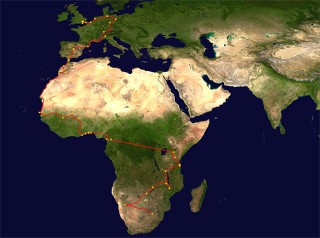
The 2010 route

The Ball 2010 left Battersea Park on 24th Jan 2010 is heading to the Opening Ceremony in Johannesburg for the 11th June 2010.

Donate a ball!

Donate a ball!

Pass the ball on! Until the start of the 2010 World Cup, all footballs donated via Alive & Kicking's website go to Special Olympics programmes in sub-Saharan Africa.

Donate now!

Most recent comments

  • Miles said:

    Ah Remi Gaillard, how you’ve taken me back to Bristol days – players to each side of the...

  • The Ball said:

    What a great idea. Way easier to give out, but a lot harder to sign!

  • The Ball said:

    Thanks for the fine compliment, Henk. Hope that following The Ball brings a smile to your face...

  • Alive & Kicking said:

    Great blog post guys. My memory of Senegal is there are plenty of table football...

  • Frank Julian said:

    What an amazing journey!

The Ball 2006

The 2006 Route

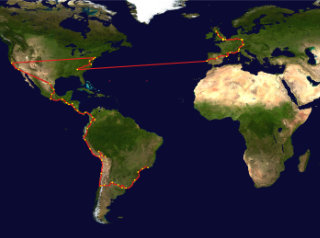
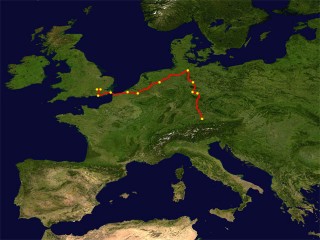
The Ball 2006 (Teamgeist) travelled from Battersea Park, London and headed to the Opening Ceremony in Munich, Germany.

The Ball 2002

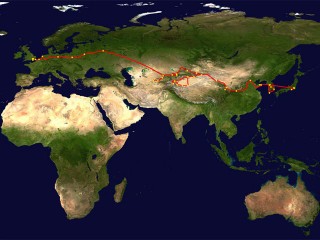
The 2002 Route

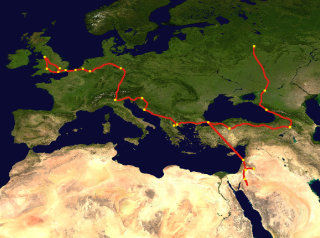
The Ball 2002 (Fevernova) was carried 7000 miles across Europe and Asia to the World Cup finals in Korea & Japan.