We bump into New Zealand’s best ever footballer — 1982 World Cup legend Winton Rufer and ask him about the Spirit of Football. His response:
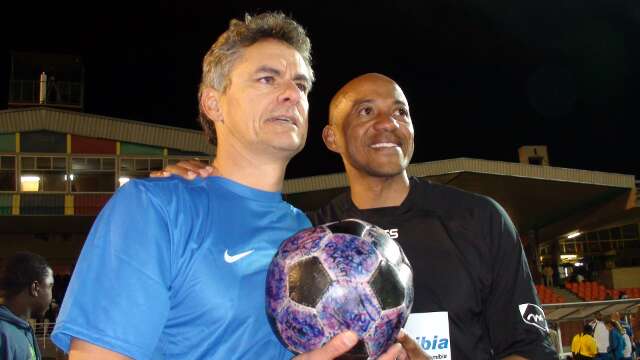 Winton Rufer, Frankie Fredericks and The Ball
“Well, we saw a little bit of it today in Windhoek, Namibia with the game Global United against African Allstars. It’s a celebration of the world’s game. The people turn out. Lots of colour. Lots of action. Having a really good time. Lots of goals as well. It can’t be better.”
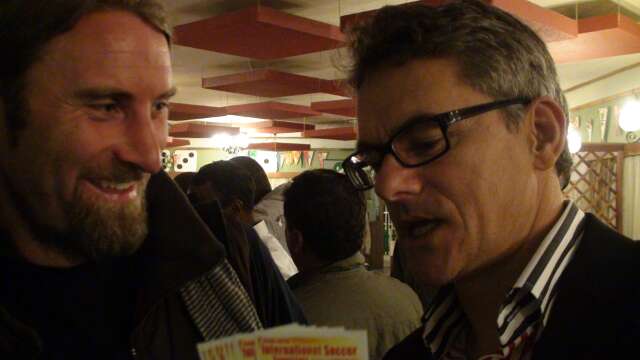 Andrew legitimately meets Winton after the game
“How will New Zealand do at the World Cup?” asks fellow Kiwi Andrew.
“New Zealand will get through, and lose the semi-final to Brazil”, replies the now grey-haired and still thick-accented Winton, with a grin.
Wouldn’t that be fab, thinks Andrew as Winton generously provides him with ten autograph cards.
“Here we have my personal signed signature cards for my Kiwi mate Andrew. So that when he goes to South Africa, he can give a few more away to show that we were legitimately together in Windhoek, Namibia.”
Overcome by Winton’s foresight and generosity, Andrew is left speechless.
Tags: Global FC, Namibia, Windhoek
Posted in Namibia, The Ball, The Journey | No Comments »
We stop by Independence Stadum in Windhoek for a game of football with a difference. Winton Rufer, from as far away as New Zealand, has travelled over 24 hours to arrive in time for kick-off. Other former stars, like 2002 World Cup Finalist Jens Novotny, have jetted in from Germany. Former Danish National Team player and regular at Bolton Wanderers, Stig Tofting, arrives from England. African legends have come in, thanks to Air Namibia, from all over Africa. Global FC have jetted in from all over the world to raise awareness for the very important global issue: climate change.
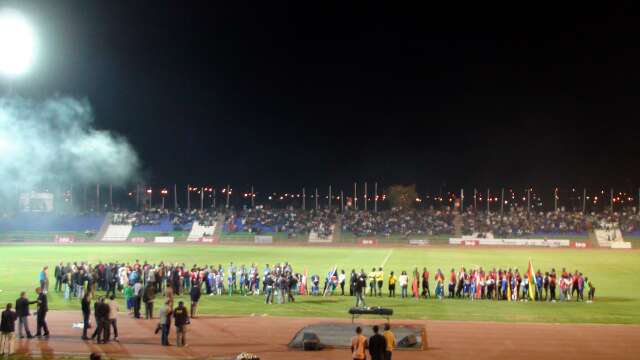 Global FC line up in the Independence Stadium
After the match, we have a chance to talk to German legend Mario Basler about the Spirit of Football.
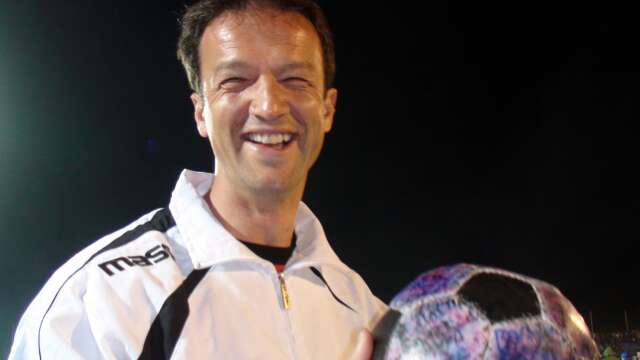 Mario Basler on The Ball
“Football is a team game. Everybody can take part in this game. If you are rich if you are poor. It doesn’t matter, you can play football. On the beach. On the streets… everywhere. That is why football is sport number one in the world.”
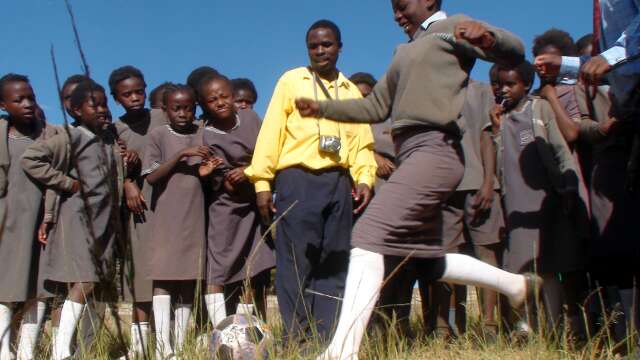
“Yesterday, we went to a township with one ball. I asked the kids if they would like to play football with us. And there was no question for them to say yes and to play football with us. This is the spirit of football.”
Tags: Football Club, Global FC, Namibia, Project Visit, Windhoek
Posted in Namibia, The Ball, The Journey | No Comments »
Could anything else other than football have brought this motley crew together? Desert Wolves bikers with a Police escort lead the cavalcade with an Olympic Torch burning brightly. Followed closely by four bright yellow DHL vehicles. The Ball held aloft on an open-top double-decker bus surrounded by the Special Olympics family, athletes, coaches and supporters.
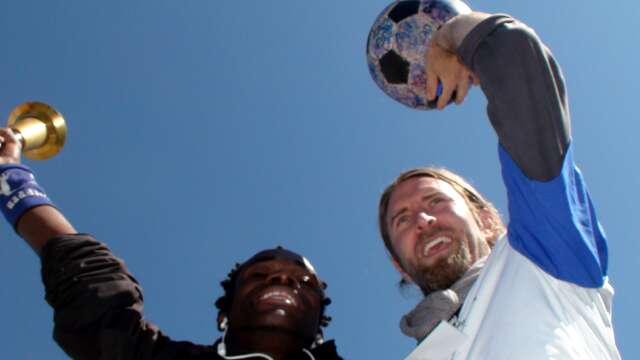 The Torch and The Ball aboard The Bus
The sound system on the bus blares out K’naan’s official World Cup anthem — on repeat and at the highest possible volume. We dance. We sing. We wave to people in their front yards. Children rush out of their homes, wave back enthusiastically, dance in the streets.
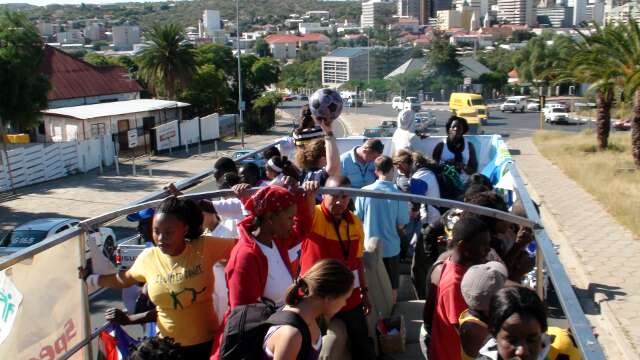 The Special Olympics family and The Ball
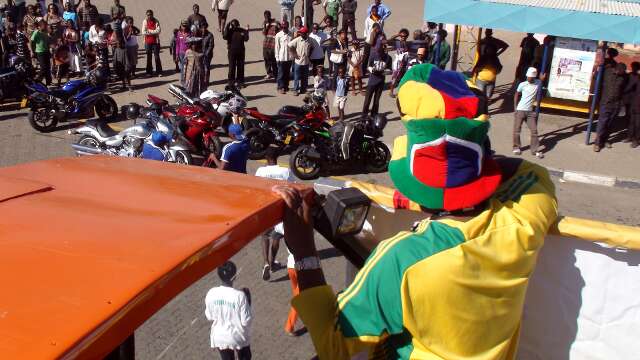 Desert Wolves gather at Katatura market
A pause in the suburb of Katatura, the so-called “place where we don’t want to be” to where the black population was forcibly relocated from central Windhoek. A tough-looking Desert Wolves biker performs a doughnut on his bike — front wheel staying on the spot, rear wheel leaving a circle of rubber on the street and acrid smoke in the air. Leaflets advertising the Special Olympics event are scattered to the crowd.
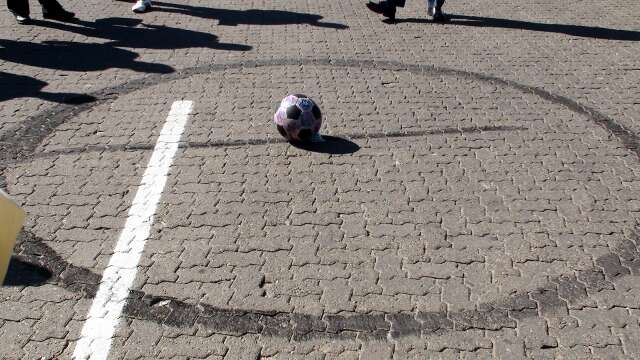 Burnt rubber: a biker leaves his mark
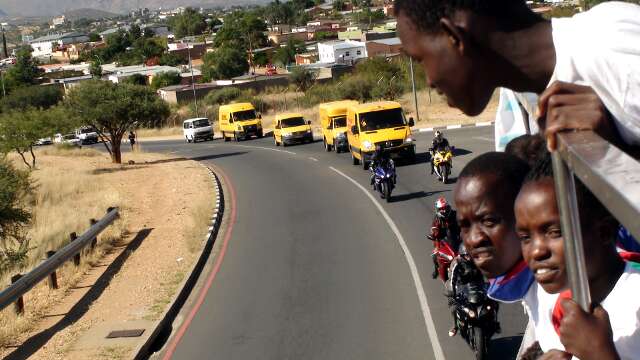 DHL vehicles follow the bus through Windhoek
Then onwards to the Sam Nujoma Stadium where the event is happening. A crowd has already gathered and football is already underway. The Ball is thrown into an inflatable football arena where children are battling it out in four-a-side competition. Football fever, World Cup fever, is here for the day.
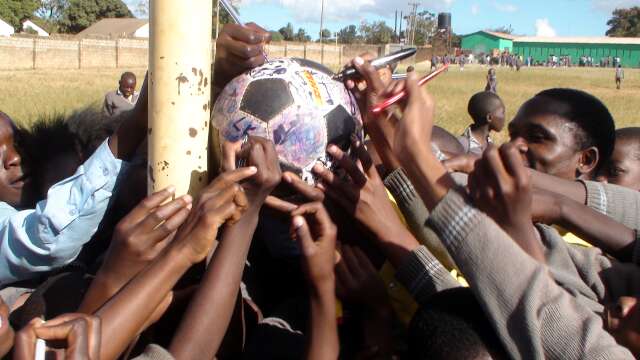
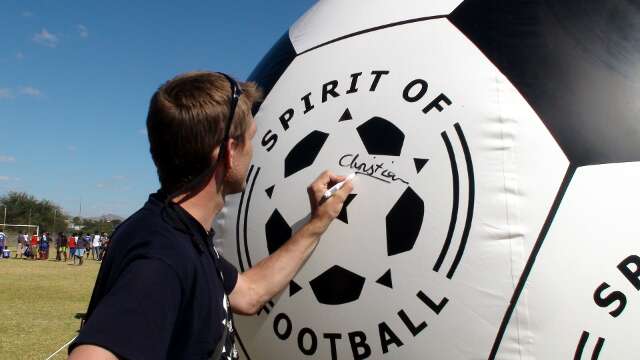 Christian signs a giant replica of The Ball
Around 2 o’clock, everyone migrates into the stadium itself for the main event of the day — a match between parliamentarians and ambassadors, both of whom, it seems, have been training hard for today’s game. Fitness levels are sky-high and play is fast and furious, diplomatic skills on full display. That’s the offical story.
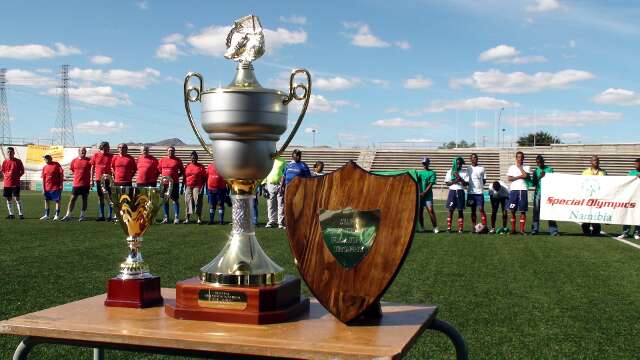 The trophy that diplomats and parliamentarians compete for
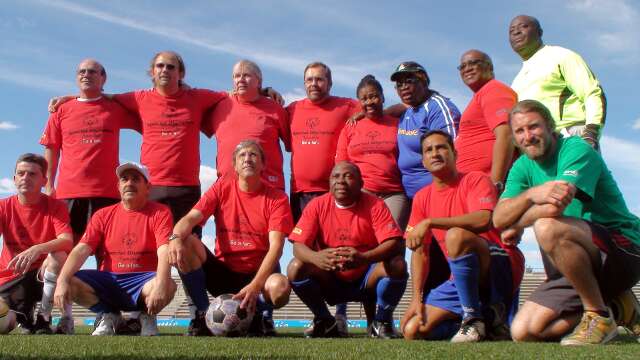 Andrew defects to the diplomats for the team photo
In truth, the game is footballing hilarity of the highest order. Diplomats fall like flies to injuries sustained in bizarre ways, while parliamentarians are making ultimate use of the tag-substitute system, more used to running the corridors of power than the length of the football field.
The game ends a 6-1 victory for the diplomats, with brave talk of a rematch from both sides. It is even proposed that future games should become regular fund-raising fixtures for Special Olympics.
 The trophy’s inscription and the fixture could be permanent
We salute both teams for their courage in getting out there on the field for Special Olympics and for showing beyond any shadow of doubt that absolutely anyone can play the beautiful game.
Tags: Namibia, Special Olympics, Unified Football, Windhoek
Posted in Namibia, The Ball, The Journey | No Comments »
Mosi, Mosi, Mosi, Mosi. It seems like Zambia has been one long, cold Mosi.
The Zambians love to party. They love to entertain. They love to have a good time. And they love to drink Mosi. Weekend in Zambia means Mosi for breakfast. Mosi for lunch. Mosi for dinner.
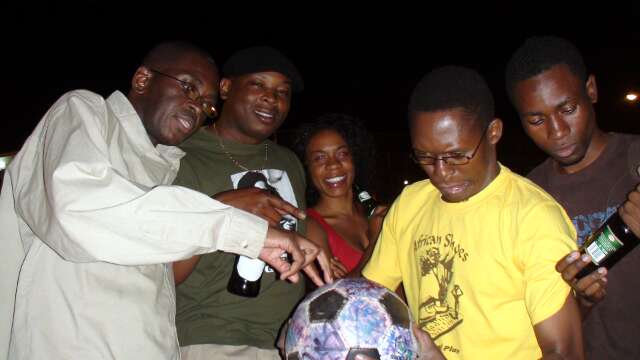 Mosi people celebrate The Ball
Not wanting to let our hosts down, we climb on board the Mosi train.
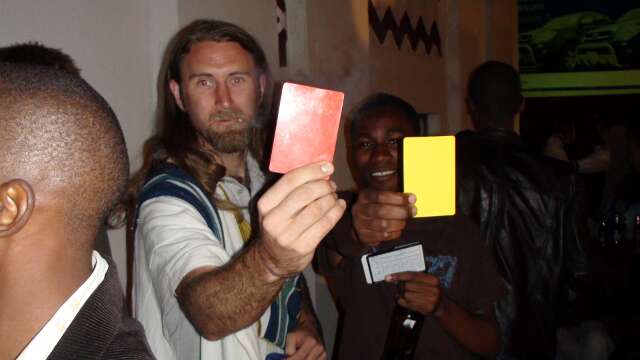 Never show Mosi the red card
Mosi. Mosi. Mosi. Mosi.
Tags: Behind the scenes, Livingstone, Zambia
Posted in The Ball, The Journey, Zambia | No Comments »
“When I have problems at work. When my boss gets on my case. When I need peace. I go outside and I listen to the falls. It totally relaxes me. I love it.”
— anonymous Zambian Mosi crew member
Rainy season was very rainy this year. Zambia suffered from flooding. Crops were ruined. People were displaced from their homes. When the rains are hard, the falls become torrential.
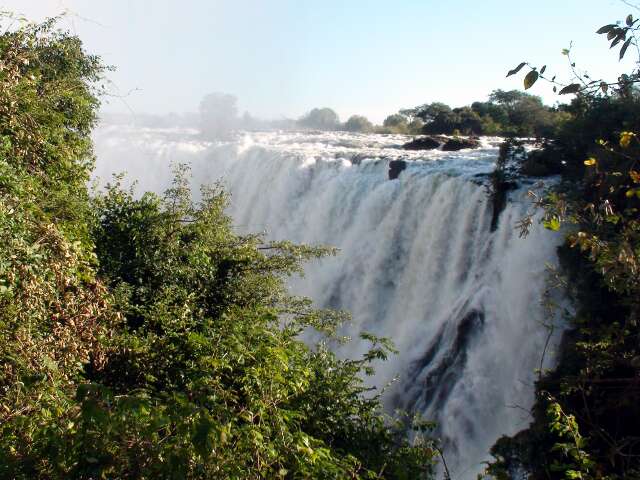 Victoria Falls in full flow
When you visit Victoria Falls in May, like we are doing, you don’t get to see much else other than huge amounts of water cannoning down 110 metres and a cloud of upside-down rain bouncing back up — half a mile high in the air. This cloud can be seen from Livingstone, 12 kilometres away.
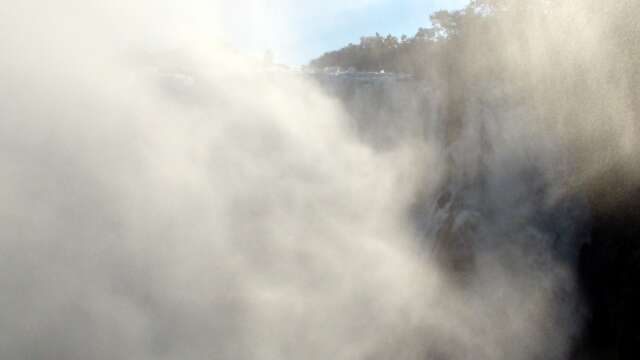 The cloud of upside down rain
The falls are thunderous, magnificent, powerful — and we need to protect The Ball. One false kick, flick, or back-heel trick would be the end of The Ball 2010. Andrew is very nervous as we get ready to do a “head-on”. You see, we film The Ball being kicked or headed on in a variety of situations and settings all the way to each and every World Cup. Victoria Falls is a backdrop that we want to film.
Elijah throws The Ball from out of screen and Christian is waiting in shot. The throw is on the money — well, Christian’s forehead to be exact. What a header! Christian directs The Ball out of frame and away, thankfully, from the falls. Andrew, soaking wet, is very relieved to collect The Ball… The Ball is safe.
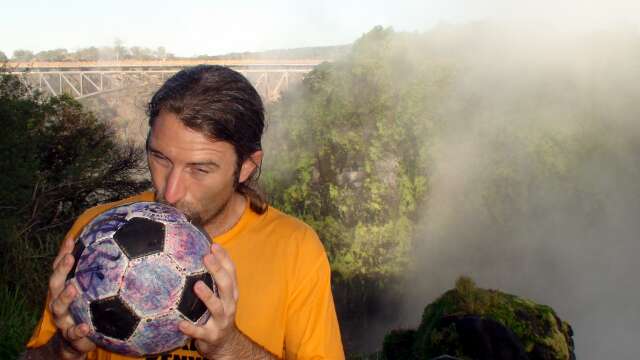 A relieved and soaked Andrew kisses The Ball
“No one can imagine the beauty of the view from anything witnessed in England. It had never been seen before by European eyes, but scenes so lovely must have been gazed upon by angels in their flight”
— David Livingstone, 1857
Tags: Freestyle Football, Livingstone, Zambia
Posted in The Ball, The Journey, Zambia | 2 Comments »
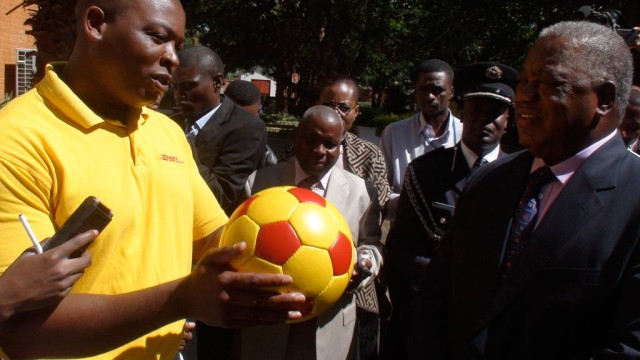
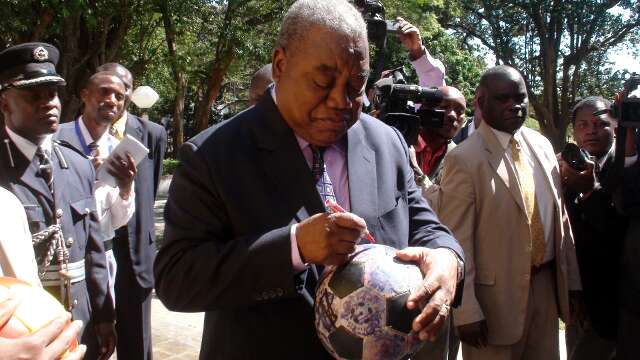 President Rupiah Banda signs The Ball at State House in Lusaka
“We are very happy that young people thought of this idea of taking The Ball around Africa. It makes us all feel part of the game. Today was the worst day you could have come to State House. We have cancelled all of the things before and after your visit. All of my ministers are here with many things to do. But we thought that it was so important, that we must attend to this.”
— Rupiah Banda, President of Zambia
Tags: Ambassador, Lusaka, President, World Cup, Zambia
Posted in The Ball, The Journey, Zambia | No Comments »
Back in Libreville in April, Andrew and The Ball took off on a DHL cargo flight headed for Douala, Cameroon. On the 28th of April 1993 another flight took off from that very airport carrying the greatest ever Zambian football team. The plane crashed and everyone on board perished. Today, we remember those fallen heroes as we visit the memorial to them at Independence Stadium in Lusaka. We pay our respects and find out more about what happened.
 Memorial to the fallen heroes at Independence Stadium in Lusaka
After refuelling successfully in Gabon the plane took off. What happened next has laid the foundations for many a conspiracy theory. A fisherman reported a huge explosion and saw the plane go down. This man was the only eyewitness and within a week he was dead. His death raised the bar, the Zambian people wanted to know what really happened. Because it was a military aircraft, there was no black-box on board and no way to find out the reason for the crash without the help of Gabon’s Government, and this has not been forthcoming.
The version that is most popular today is that one engine caught fire, the pilot made a mistake in shutting down the good engine instead and the plane crashed. But we still do not know exactly what happened.
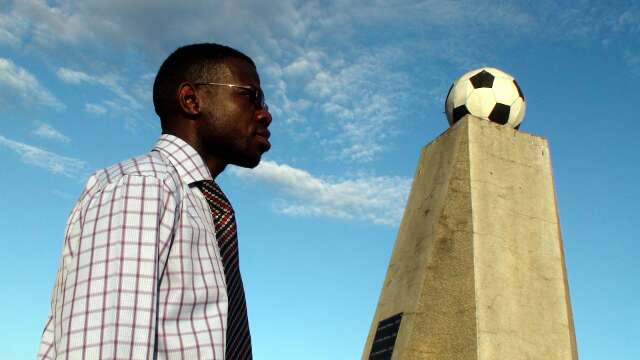 The saddest day in Zambian history is remembered
What we do know is that players, coaches, administrators, and journalists were all on board. Their remains were brought home and buried right here outside of the national stadium. The monument here, and the graves of the fallen, are a shrine. The Zambians still mourn the loss of those heroes. They still come here, 17 years on, to pay respect to the dead, and they still sing songs about those players at every home match in Independence Stadium. And they still wonder what might have been.
Today, we mourn those players as the sun goes down. Then, together with emotional Zambian football officials, we enter Independence Stadium, accompanied by twenty barefoot kids. Accompanied by a national team striker, we kick The Ball on the pitch. The ear to ear smiles on the faces of the youngsters brighten up the atmosphere. They are living the dream…
 Kids allowed to play in the National Stadium with The Ball
“Normally this pitch if reserved for the professionals and the national team. We are making an exception today for you and The Ball.”
Tags: Disaster, Football History, Lusaka, Peril, World Cup, Zambia
Posted in The Ball, The Journey, Zambia | No Comments »
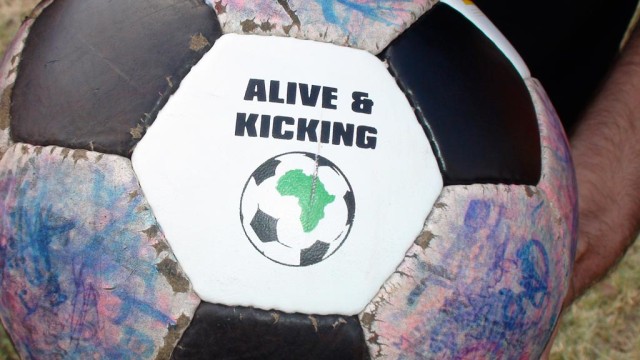
The Ball’s been on the road for well over one hundred days now. Its been played in perhaps seven hundred kick-abouts — on streets, in parks, it even joined the mile-high kick club when it was kicked by pilots in the cockpit en route to Lagos. The Ball has been around the block and it’s starting to look a little worse for wear. Luckily, our partner Alive & Kicking has a stitching centre in Lusaka.
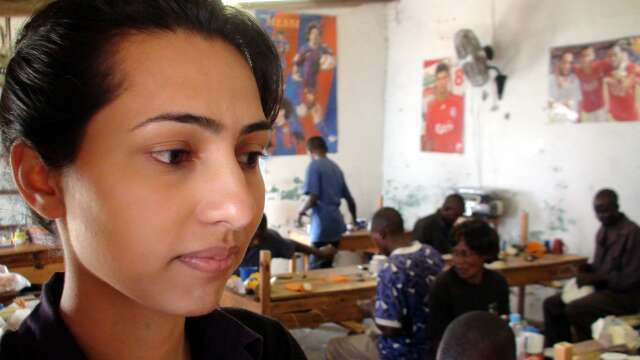 Sughra Hussein, acting Director Alive & Kicking Zambia at the factory in Lusaka
Christian hasn’t seen The Ball being operated on. And the anguished look on his face as The Ball doctor opens The Ball up is one that any worried parent can relate to. His eyes bulge, his mouth gapes… he looks white as a sheet (well, he always does — he’s English).
Before long, five panels have been removed.
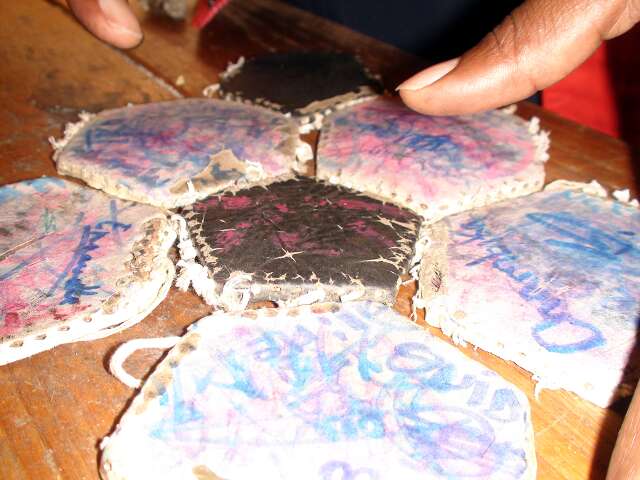 5 damaged panels on A&K workbench
The Ball doctor still isn’t satisfied and looks to get cracking on the bladder. “Stop! Please. Now”, says Christian. She does.
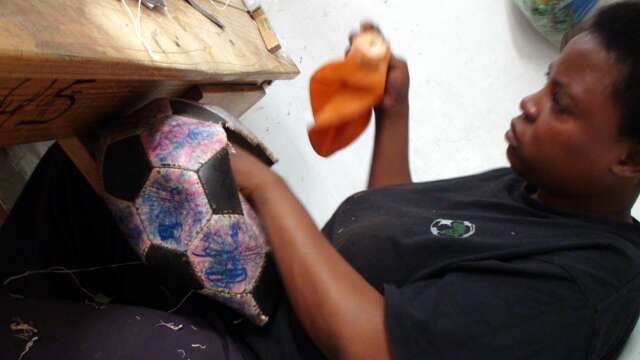 Bladder what bladder?
We’ve brought a bladder and a few spare panels from Nairobi. Alive and Kicking provide a few Zambian panels too. The Ball is becoming more African by the day!
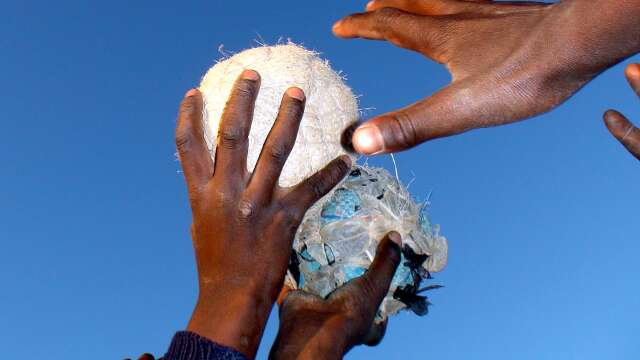
The operation is a success but The Ball looks very strange. Even stranger than it did in Nairobi after having 2 panels replaced. The Ball looks rather like the result of a serious head-on ball collision. Two balls have merged into one.
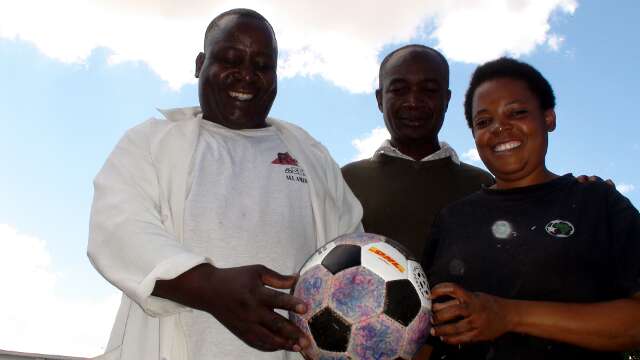 Alive and Kicking Zambia stitchers and The odd Ball
It is going to take a live kicking or ten before The Ball can bounce evenly again.
Tags: Alive & Kicking, Behind the scenes, Lusaka, Project Visit, Zambia
Posted in The Ball, The Journey, Zambia | No Comments »
It’s the last ball of the over, in runs the young medium pacer, bowling over the wicket, off a short run-up. But what’s that in his hand? It’s The Ball. And what a delivery — right up there in the block hole. The Ball hits the batsman about knee-height on his front pad. There’s a large shout for LBW. It looks plum. The umpire’s hand goes up. He’s out. Howzat!
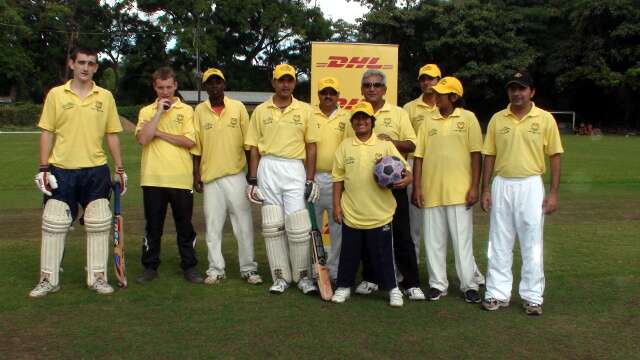 The DHL cricket team are on The Ball
Thanks to the DHL cricket team for being good sports. It may not quite be the Spirit of Football, but it’s certainly the Spirit of Cricket.
Tags: Blantyre, Cricket, Malawi
Posted in Malawi, The Ball, The Journey | No Comments »